FIRST24 RESEARCH GUIDE

What does the evidence actually show about nasal and oral antiseptics?

30 selected research records explained in plain English—including promising findings, null results, safety evidence, funding disclosures and FDA context.

One-time purchase · 14-day refund policy · Educational, not medical advice.

The evidence in five answers

Laboratory evidence
Povidone-iodine has inactivated several viruses under laboratory conditions.
Human evidence
Results vary by formulation, population, timing and endpoint.
Early use
Some findings support investigating timing, but no universal window has been established.
Safety
Short-term use has been studied; suitability depends on formulation and individual factors.
Regulatory status
Laboratory activity and patents do not equal FDA approval for preventing or treating respiratory infections.
Why I began — Paul Gathua, founder

Paul Gathua is the founder of First24 Health Systems and Aura: Family Moments & Stories. After more than twenty years in healthcare, his work now spans health, family, identity and information technology, with 155 patent and patent-pending applications.

I spent more than twenty years in healthcare. During the pandemic, I became ill. Soon after, my children did too. Any parent who has watched a respiratory infection move through the household knows that particular ache—the worry, the guilt, and the wish that you could have interrupted it before someone you love got sick. I could not undo what happened. But I could look for better answers. That is where this work began.

These experiences did not give me an answer. They gave me a responsibility to investigate the question properly.

So I read the trials, the laboratory papers, the null results, the safety reports and the regulatory letters. An observation is not evidence; this guide separates the two and shows you each source so you can check every step yourself.

I am not asking readers to accept my experience as proof. I am inviting them to understand why the question deserves serious, honest investigation.

First24 also develops workplace programs related to this research. This guide sells no physical product and recommends none.

Read three study notes free

One promising result, one disappointing result and one safety finding, condensed from the guide. No sign-up required.

Promising human finding

Starting earlier improved a saliva-virus result.

What was tested
Povidone-iodine oral rinse and gargle, started on study day 2 versus day 5 (water first, then delayed povidone-iodine).
Who was studied
430 randomized people aged 16 or older with asymptomatic-to-mild COVID-19; 279 initially saliva-PCR-positive.
What happened
Day-5 saliva PCR clearance was 34.5% with earlier start versus 21.4% with delayed start (P=.015); infectivity also favored early intervention.
What it may mean
Timing may matter for a virologic measure, which supports investigating it further.
What it cannot establish
The clock began at study enrollment, not exposure. Symptoms did not clearly differ; by day 6 the test-result difference was also unclear. This was gargling, not nasal spraying, and the trial was open-label.
Funding / manufacturer involvement
Not fully extracted in this edition; inspect the original disclosure.
Direct source
Matsuyama A, Okura H, Hashimoto S, Tanaka T · Scientific Reports, 2022https://www.nature.com/articles/s41598-022-24683-8
Null or disappointing human finding

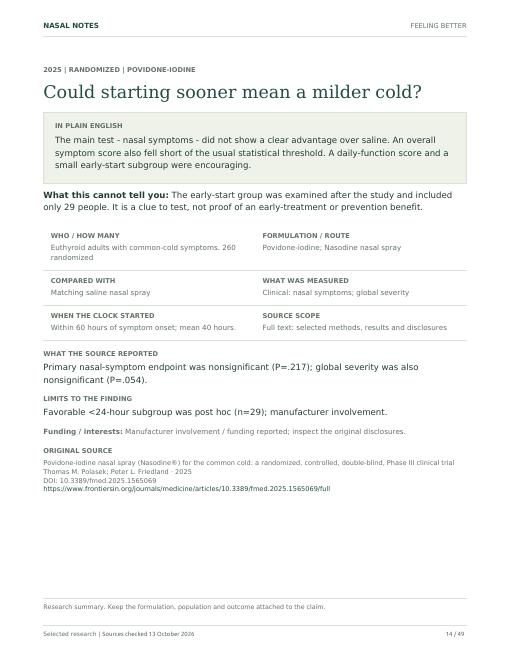
Could starting sooner mean a milder cold?

What was tested
Povidone-iodine nasal spray (Nasodine) compared with a matching saline nasal spray.
Who was studied
260 randomized euthyroid adults with common-cold symptoms, treated within 60 hours of symptom onset (mean 40 hours).
What happened
The primary nasal-symptom endpoint was not significant (P=.217); global severity also fell short (P=.054). A daily-function score and a small early-start subgroup were encouraging.
What it may mean
The early-start subgroup is a clue to test in future studies.
What it cannot establish
The favorable under-24-hour subgroup was examined after the study and included only 29 people. It is not proof of an early-treatment or prevention benefit.
Funding / manufacturer involvement
Manufacturer involvement / funding reported; inspect the original disclosures.
Direct source
Polasek TM, Friedland PL · Frontiers in Medicine, 2025https://www.frontiersin.org/journals/medicine/articles/10.3389/fmed.2025.1565069/full

Safety / tolerability finding

A virus signal came with a safety signal.

What was tested
Povidone-iodine mouthwash, gargle, nasal spray and ointment for five days, compared with no intervention.
Who was studied
24 nonsevere COVID-19 outpatients (12 per group) with a highly positive test in the previous 48 hours.
What happened
The PCR (RNA) trend did not differ, while early live-virus decline was greater. A thyroid-related blood marker (TSH) rose in all 12 treated people; five went above the normal range before returning to baseline.
What it may mean
Repeated, intensive povidone-iodine exposure can produce a measurable thyroid signal that deserves attention.
What it cannot establish
T3 and T4 levels did not change; a temporary blood-test change is not a diagnosis of thyroid disease. The study was small, had a baseline age imbalance, and combined routes—not a nasal spray alone.
Funding / manufacturer involvement
Not fully extracted in this edition; inspect the original disclosure.
Direct source
Guenezan J et al. · JAMA Otolaryngology–Head & Neck Surgery, 2021https://jamanetwork.com/journals/jamaotolaryngology/fullarticle/2775984

Three distinctions before you read anything else

01

Viruses need living cells.

Viruses use living host cells to make new copies of themselves. That does not make them “weak,” and how long a virus remains infectious outside the body varies by virus, surface and conditions.

02

The nose can be an early site, not a stopwatch.

SARS-CoV-2 can replicate in nasal ciliated cells. Coronaviruses replicate mainly in membrane compartments in the cell’s cytoplasm, not in the nucleus — and there is no universal 24–48-hour nose-to-lung sequence.

03

A lab result is a lab result.

Laboratory studies have shown that povidone-iodine can rapidly inactivate SARS-CoV-2, influenza A, Ebola and HIV—evidence of broad activity against very different viruses. In one controlled laboratory study, a tested nasal formulation containing 0.5% povidone-iodine rapidly inactivated SARS-CoV-2 after 15 seconds of contact.In-vitro contact-time result only. It is not proof that nasal use prevents illness, improves recovery, or is safe for repeated use.

Four separate gates

Most summaries blur these questions. This guide keeps them separate.

  1. 1

    Laboratory activity

    Evidence exists under specific tested conditions.

  2. 2

    Patent protection

    Patents protect defined claims; they do not prove clinical benefit.

  3. 3

    Human clinical evidence

    Mixed and specific to formulation, population, timing and endpoint.

  4. 4

    FDA approval for these respiratory uses

    No.

Patent and FDA details, with direct sources

A patent is not an approval. A warning is not a dismissal of the science. Patent offices and the FDA answer different questions.

Patent offices

Firebrick’s claims gained protection in multiple jurisdictions.

  • Australia granted Firebrick Pharma patent AU2020280226B2 in 2025 for claimed methods involving intranasal povidone-iodine and highly pathogenic viruses.
  • The separate U.S. common-cold patent US11000542B2 was granted in 2021, not 2025.
What that means
Patent offices granted legal rights over defined claims.
What it does not mean
A patent is not FDA approval, endorsement, or proof of clinical benefit.
Direct sources
U.S. Food and Drug Administration

FDA warning letters drew a line around product claims.

FDA letters to Halodine, Viraldine and CofixRx described the named nasal antiseptic products as unapproved new drugs and challenged claims that they prevented, treated, or mitigated COVID-19.

The CofixRx letter also objected to language implying that an ingredient’s status made the nasal product FDA approved.

What that means
Ingredient, formulation, route, intended use and marketing claim are separate regulatory questions. Laboratory activity alone did not authorize those disease claims.
What it does not mean
The letters did not erase laboratory findings or decide every possible future formulation. Each addressed identified products and claims, and stated that no approved application was then in effect for the named product. FDA did not validate the underlying science, and the warnings stand as written.
Direct sources

What is inside

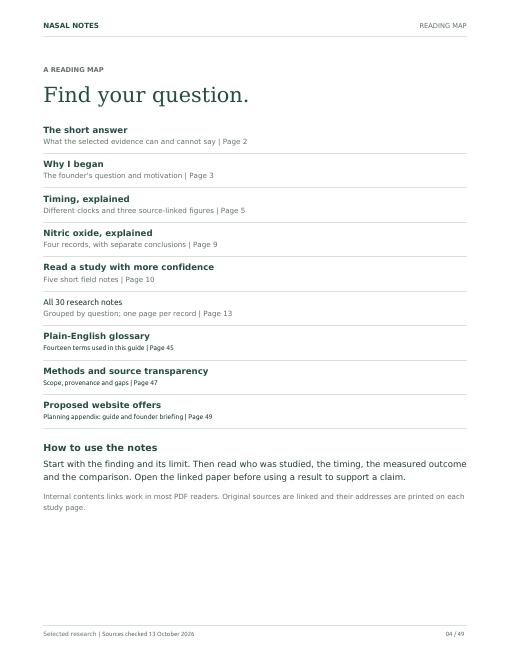
  • — A short answer: what the selected evidence can and cannot say
  • — Timing explained, with three source-linked figures
  • — Five short field notes on reading a study with more confidence
  • — 30 research notes, one page per record, grouped by question
  • — A plain-English glossary of fourteen terms
  • — Methods and source transparency: scope, provenance and gaps
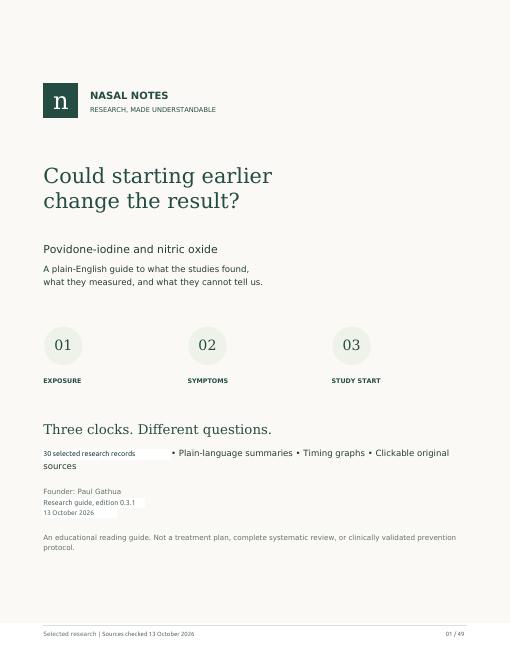
Guide cover page (Edition 0.3.1, cover titled Nasal Notes)
Cover
Reading map page listing the guide's sections
Reading map
Sample study-note page on a 2025 povidone-iodine common-cold trial
A study-note page

Research guide · Edition 0.3.1 · Part of the First24 Interceptive Protocol™

The First24 Nasal & Oral Antiseptic Evidence Guide

  • — 49 carefully designed pages
  • — 30 source-linked research records
  • — Timing made visible
  • — Positive, null, safety and manufacturer-involvement findings, side by side
The First24 Nasal & Oral Antiseptic Evidence Guide
$39USD, one-time · tax included

Research guide · Edition 0.3.1 · 49 pages · 30 selected research records · PDF

The current Edition 0.3.1 PDF cover and page headers retain the earlier title “Nasal Notes.”

  • No subscription. Future editions are sold separately.
  • No product, spray, recipe, dosing plan, diagnosis, or promised outcome.
  • Delivery: a private download link after payment is confirmed. The link allows up to 3 downloads and expires 72 hours after it is issued. Lost access or changed browser? Email us from your checkout email and we will verify the purchase and send a fresh private link.
  • Refund policy: request a full refund for any reason within 14 days of purchase by emailing hello@first24.io from your checkout email. Refunds go to the original payment method. This policy is subject to applicable law and does not limit any rights you have under it. Buying the guide is not a medical consultation and does not change the disclaimers above.